Spending a trimester, a semester, or a full school year at a high school in Mexico means living in Spanish from the moment you wake up: at the breakfast table, in class, with friends at the weekend. Mexico is the most populous Spanish-speaking country in the world, and a place where history, food, and family life are part of everyday conversation.

This guide to High School Abroad programs in Mexico explains how Mexican schools work, what daily life looks like, and how to choose between the two places where Nacel places students: Mexico City and Mérida.

High School Abroad Mexico - High School exchange exchange in Mexico - Exchagne program for Students in Mexico

Classic High School Exchange in Mexico

Spend a trimester, semester, or academic year in Mexico, attending a private high school and sharing everyday life with a Mexican host family. This exchange brings language learning into your daily routine. Follow lessons in Spanish, get to know local classmates, and discover Mexican culture through school and family life.From classroom conversations to meals with your host family, each day offers opportunities to practise Spanish and grow more confident in a different environment.

Read more
  • Ages: 14 to 18

  • Real immersion in Spanish

  • Live in a family-oriented neighborhoods

  • Experience Mexican culture

From : 5,855 EUR

~ -- --

Discover more
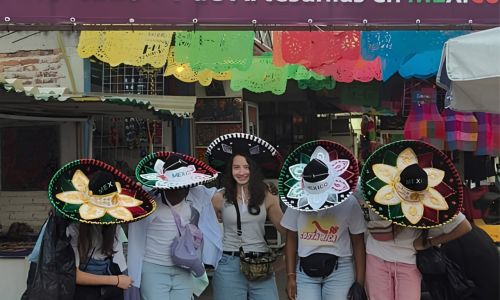
High School Abroad Mexico - High school Abroad in Yucatan - mercado de artesanias

Select High School exchange in Yucatan

Explore Yucatan during your high school abroad in Mexico! Explore this wonderful region with a strong Mayan heritage and immerse yourself in Mexican culture. Live and study in Mérida!
Discover our High School year abroad program in Yucatan. 

Read more
  • Ages: 14 to 17

  • Safest region in Mexico

  • School placement confirmed early

  • Close to Tulum, Chichen-Itzá, Uxmal, Cancun

  • Explore Mayan heritage

From : 5,480 EUR

~ -- --

Discover more

A Legacy of Confidence and Success in Cultural Exchange

With decades of experience, certified quality, global partnerships, dedicated support, and a commitment to safety, Nacel ensures every student embarks on a transformative journey with confidence and trust.

Be a high school exchange student in Mexico!

3000 years of history have built up a country with a rich culture and lots of traditions. The school year abroad in Mexico allows international high school exchange students to experience Mexico from the inside: live with a local host family, go to school with your host siblings, participate in extracurricular activities in your private school, and explore the delicious Mexican food!

Mexico has the largest Spanish-speaking population in the world and a very mixed population made up of people having indigenous, European, and African ancestry. Mexico is a federation of States but has a strong national identity.

Mexico is known for its metropolises such as Mexico City, which has 20 million inhabitants. We place exchange students in private secondary schools in either Mexico City or Mérida. These private schools offer excellent study facilities.

Host families are recruited among families having their children at school. During their High School Study Abroad in Mexico, exchange students thus really integrate into the local community and quickly feel part of it. A typical host family is from the middle class and receives a small stipend to host, but decides to host a student coming from a foreign country to share its everyday life and the culture the Mexicans are proud of.

Explore Mexico not as a tourist but as a guest of a local community and experience the culture from the inside! Embark for a school year abroad in Mexico.

​School Year Abroad in Mexico : Free Parent and Student Consultation​

Why choose Mexico for a high school year abroad?

Real Spanish immersion. Classes are taught in Spanish, your host family speaks Spanish, and so do your classmates. There is no international bubble to retreat into, which is exactly why progress comes quickly.

A rich culture. Mexican identity is made of indigenous heritage, Spanish colonial history, and a modern present. Experience the Independence Day celebrations in mid-September, Día de Muertos at the start of November, or Las Posadas in December!

Family is central in Mexican culture. Weekends often mean long meals gathering with relatives and neighbors. You feel part of a bigger family. 

Food that you will love. From street tacos to regional specialties, eating is one of the easiest ways to start conversations and make friends. And Mexican food is so delicious! 

How Mexican high school works?

Mexican education moves from primary school to secundaria and then to upper secondary school, known as preparatoria or bachillerato, which covers roughly Grades 10 to 12. This is where most exchange students are placed.


A few things to know before you go:

  • Everything is in Spanish. Subjects follow the local curriculum, with English as a regular school subject.
  • You join a class group. You will usually share most lessons with the same classmates, which makes it easier to form friendships.
  • The school day is short. It is typically five to six hours, and clubs and sports vary a lot from school to school.
  • Uniforms are common. Some schools require a full uniform; others only a school shirt.
  • It is an exchange year, not a diploma year. Students do not graduate from a Mexican school during the program. Check with your home school about recognizing the year.

Mexican school system: Key facts

  • The school year runs from early September to June, with the end date varying by school. There are holidays in December, in April and over the summer.
  • Classes run Monday to Friday. Some schools have a morning schedule (about 7:00-7:30 am to 1:00-1:30 pm). Others run an afternoon schedule, which can start as late as 2:00 pm and finish at 9:00 pm.
  • Schooling is compulsory from age 3 to 18.
  • Nacel places exchange students in private schools. Some are bilingual or have a religious foundation, and they are typically more affordable than international schools.
  • Students follow the standard Mexican curriculum in Grades 10 and 11, and often Grade 12.
  • Students have about five or six classes a day, with a short morning break and a longer midday break for lunch.
  • Subjects include physics, biology, chemistry, Mexican history, and world history. Some schools also offer psychology or Mexican law.
  • Spanish literature is not a language course for foreigners. It is a study of Mexican or Spanish literature, so it can be challenging at first.
  • Students also study a foreign language, usually English or French. It is taught as a course for non-native speakers, so it is unlikely to count as an English or French credit back home.
  • Extracurriculars: Schools offer fewer clubs than American schools. Most students play sports or do activities in community clubs outside school. Soccer and basketball are the most popular sports.
  • Grading: On a 0-100 scale: 90-100 is excellent (about an A), 80-89.99 is good (B), 60-79.99 is sufficient (C), and below 60 is a fail (F). On a 0-10 scale: 9-10 is excellent, 8-8.99 is good, 6-7.99 is sufficient, and below 6 is a fail.

Want to learn more about daily life at a Mexican high school and get advices on how to succeed? Read more in our blog about how will your school year abroad in Mexico will look like. 

When and how long you should go?

The Mexican school year starts in late summer and runs until June or July. Nacel start windows fall at the beginning of the school year (August or September) and in January, with an additional spring start for some programs.

A trimester gives you a first taste of immersion, a semester is long enough to settle in and see real progress, and a full year lets you live through the entire school cycle and become really fluent.

Exact start dates, prices, and deadlines are available on the program pages. As a rule, begin planning several months in advance: you will need an interview, documents, and, depending on your nationality and length of stay, a visa.

How is the Mexican host family experience?

You live with a local family, often connected to your school community, and share meals, routines, and weekends. Expect to be treated as a member of the family: you will be asked to take part, to talk, and to help around the house.

That daily contact is where most of your Spanish will come from.

Mexico City or Mérida? Choosing your host city.

Nacel places students in two very different cities.
Neither is better; the right one depends on the kind of year you want.


Mexico City
Mérida (Yucatán)
Environment
One of the largest cities in the world
Fast, busy, always something on
Colonial city in southeastern Mexico
Calmer, smaller scale
What you can explore
Historic center, museums, neighborhoods like Coyoacán
Mayan heritage, colonial architecture, Caribbean coast within reach
Experience
A big-city, capital experience
Regional traditions, nature

Want to lear more? 

See the high school exchange in Mexico City or discover the high school exchange in Yucatán.