

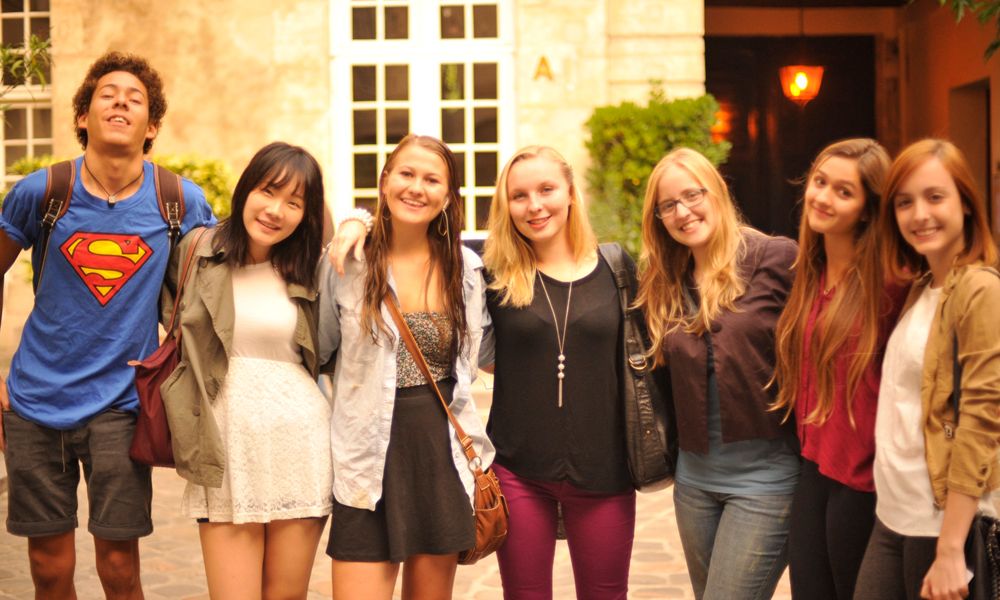



Study abroad in France, improve your French, and discover everyday life in another culture. Live with a volunteer French host family and attend a local French high school for a term, semester, or academic year.
Experience France from the inside, not as a tourist, but as a local student.
Next available start dates: August 2027 and January 2028. Applications are now open.
Last minute for the Spring Semester 2027 starting in January 2027? Contact us now.
Live with a French host family and study in a local High School in France
Nacel offers a cultural exchange program in France for native English- and Spanish-speaking students who are already studying French at school. Students live with a volunteer host family and attend a French lycée for a few months or an entire academic year. This immersive high school exchange program gives students the opportunity to :
- improve their French,
- experience everyday life in France,
- and become more independent and culturally aware.
Placements are available in communities throughout France. International students attend classes alongside local students and participate in school life just like their French classmates.
Students who would like to graduate from a French lycée must normally complete both Grade 11 and Grade 12 in France and successfully pass the required examinations.
Please note that this cultural exchange program is currently available only to native speakers of English or Spanish. If your first language is different, please contact us to learn more about our other high school programs in France.
Subjects, Grades, and Academic Credits
Before enrolling in a high school exchange program in France, students should speak with their school counsellor to determine how their studies abroad will be recognised by their school or educational authority at home.
- If a grade report is required at the end of the program (Full academic year or semester program only), please provide your Nacel counsellor with a list of any specific subjects you are required to study. Nacel recommends that students arrange a meeting with their school counselor to determine what subjects they need to attend while abroad, to be able to earn credits from their study abroad program.
- Your French level may determine whether your teacher is able to grade you in a given subject.
- An official transcript from your host school in France isn't guaranteed, even if most schools would provide one. Some schools will instead provide letters or other documentation on request, provided you maintain good behavior, attendance, and performance.
- If you wish to graduate from a French High School, you must generally complete Grades 11 and 12 in France and pass all required examinations.
- If you do not need to earn academic credits, your time in France will still provide valuable international experience that can strengthen your academic and professional profile.
Academic credit cannot be guaranteed, as recognition procedures vary between countries and schools. Although Nacel is not responsible for determining the requirements in a student’s home country, our experienced team will provide guidance and support throughout the process.
Learn more about the French high school system:
- How will my grades look if I'm an exchange student in France?
- Learn more about the French grade report you may earn during your High School Study abroad in France
- 10th Grade in France: what to expect in Seconde
- 11th Grade in France: what to expect in Première
What can I expect from my exchange program in France?
- Nacel’s Classic High School Exchange in France is specially designed for native English- and Spanish-speaking students who are learning French. Volunteer host families are interested in welcoming students who can introduce their family to another language and culture. This makes the placement a genuine two-way cultural exchange.
- Students are placed with carefully selected volunteer host families throughout France.
- Students who arrive in late August for the September school intake take part in a three-day cultural and language orientation in Paris. This is also an opportunity to meet other international exchange students before travelling to their host communities.
- Throughout the program, every student receives support from a local coordinator. A 24/7 emergency assistance line is also available.
Who is the Classic high school exchange program in France for?
This program may be a good choice for students who:
- are happy to be placed in any region of France;
- consider their relationship with their host family to be an essential part of the experience;
- are looking for an affordable high school exchange program in France;
- are flexible and willing to adapt to their host family’s lifestyle and customs;
- are comfortable living in a small town, village, or rural community;
- want an immersive experience within a French family and local community;
- are ready to spend time with their host family and actively participate in everyday family life.
This program may not be the best option for students who:
- want to choose a specific region of France: if you would like to choose an area, have a look at our high school program in selected French boarding schools or at our Select City placements;
- specifically want to live in a medium-sized to large city: choose our Select City placements;
- want to study and live in the Paris area: choose our English-speaking High School Exchange in Paris or the Select City placements;
- do not feel comfortable living with a host family: choose our full-time boarding school options;
- are looking for a shorter experience: Come for 2 to 10 weeks to experience French cultural immersion in a host family and French school.
Compare all our High School Abroad programs in France.
If you are a beginner in French or wish to study in English while you are in France, visit the website of our English-speaking high school in the Paris area. You will attend American subjects taught in English. You will attend one one-hour French class every day and also have the opportunity to live with a French host family to practise your French!
Need more guidance to choose your experience?
Student Experiences in France
Imagine starting your day with breakfast in your French host family’s home, attending classes alongside local students and spending your evenings practising French naturally around the dinner table. Over time, unfamiliar routines become part of everyday life, new classmates become friends, and France begins to feel like a second home.
- How has studying abroad changed my life? A testimonial of an Australian exchange student in France
- From a high school exchange in France to Sciences Po Paris: Aaron's story.
- Study Abroad in France: Saskia's Student Exchange Experience
- Mealtime during your French immersion in France
What will you take home?
Your exchange does not end when you leave France. You will return home with:
- stronger French skills,
- greater independence,
- international friendships
- and a deeper understanding of another culture.
These experiences can continue to shape your studies, career choices, and outlook for years to come.
Exchange students experience the everyday life of a French teenager. Classes generally take place from Monday to Friday, during both the morning and afternoon, and the school day may finish at 5:00 or 6:00 p.m. Some schools do not hold classes on Wednesday afternoons.
Students are encouraged to take part in extracurricular activities, as these are an excellent way to make friends, become involved in the local community and practise French.
Some schools offer sports and cultural activities. Students may also be able to join local sports clubs, music groups or other community organisations outside school.
Living with a French host family
During your high school exchange in France, you will live with a volunteer French host family. Volunteer families are not paid to host international students but receive a small stipend to help them cover some extra living costs. They participate because they are genuinely interested in cultural exchange and in learning about another country, language, and way of life.
Students are expected to become active members of their host family. This means spending time together, participating in everyday activities and sharing information about life and culture in their home country. Open communication and a willingness to adapt are essential to a successful host family experience.
Before placing a student, our local coordinators carefully screen prospective host families and consider the student’s needs, personality, and interests.
Living with a French host family provides daily opportunities to practise French naturally. As your confidence grows, you may soon find yourself thinking, and even dreaming in French!
Host Family Screening
Every host family goes through a thorough vetting process before they're approved, so participants can feel confident they'll be placed with a suitable, trustworthy household. To qualify, prospective hosts must:
- Pass a criminal background check
- Complete an in-person interview with program staff
- Agree to and pass a home inspection
Arrival in France
Flights are the student's own responsibility to arrange. Once accepted, you'll receive your program's start and end dates along with the recommended arrival and departure windows, giving you what you need to begin looking at flight options. Airport pickup on arrival is covered as part of the program. Before booking anything, though, you'll need to send us your proposed flight itinerary for approval.
Soft Landing Camp in Paris
During the Orientation and Soft Landing Camp, students receive practical guidance about:
- French school life,
- host family expectations,
- cultural adjustment,
- communication and safety.
They also take part in language and cultural activities and meet other international exchange students before travelling to their host communities.
Meeting your host family
You'll be connected with your host family before you even set foot in France. Exchanging emails or having a call ahead of time helps you get comfortable with one another, so that first face-to-face meeting feels a little more familiar.
Ongoing support throughout your program
Nacel monitors your experience and progress through regular check-ins with you, your host family, and your host school. Your local coordinator will visit you and your host family at least once per term and whenever additional support is needed.
You can contact your national coordinator via a dedicated WhatsApp group on weekdays. You and your parents will also have access to a 24/7 English-speaking emergency assistance line throughout the program.
High School Exchange Program in France with Volunteer Host Families 2027/2028
Prices valid for August 2027 and January 2028 start dates.
Program dates 2027/2028:
Academic Term :
- August 24, 2027 to December 18, 2027 (with orientation/ soft landing camp)
- January 15, 2028 to April 22, 2028 (with mini orientation)
- March 5, 2028 to June 10, 2028 (no orientation)
Academic Semester :
- August 24, 2027 to January 15, 2028 (with orientation/ soft landing camp)
- January 15, 2028 to June 10, 2028 (with mini orientation)
Full Academic Year:
- August 24, 2027 to June 10, 2028 (with orientation/ soft landing camp)
- January 15, 2028 to December 16, 2028 (with mini orientation and no accommodation during the summer break from mid-June to the end of August) = specific cost; please inquire
Optional Pre-School French Preparation Course: August 15 to 27, 2027
Orientation/Soft Landing camp: August 24 to 27, 2027
LAST MINUTE SPRING 2027: Interested in joining the Spring 2027 semester? Contact us now to check last-minute availability.
With clear program fees and several duration options, Nacel makes it easier for families to choose an exchange experience that matches their goals and budget.
* Price in Euros per participant.
Not included: Application Fees (65 EUR)
On offer:
- Term Abroad France
- Semester Abroad France
- School Year Abroad France
- High School Summer Abroad France
Payment Schedule
- Application Fee: $300 USD, paid online when you submit your booking to officially begin the application process
- Acceptance Deposit: €600, due shortly after you're admitted, to confirm and secure your place in the program
- Final Balance: the remaining program cost is due 3 months before your arrival in France. If you're accepted less than 3 months before your start date, the full remaining balance becomes due immediately upon acceptance, alongside your deposit.
💰 What's Included in the Price?
- Administration fees
- School registration and tuition fees
- Host family accommodation with all meals (including school lunches)
- Pre-departure advice and support
- Visa assistance: guidance and paperwork support for your visa application before arrival
- Support from in-country staff upon arrival to France.
- Access to a 24/7 emergency assistance line
🚫 What's Not Included?
- Round-trip international airfare
- Travel insurance (luggage loss, flight delay etc.)
- Visa, passport and medical examination fees
- Optional sports, excursions and activities organised by the school or other providers
- Additional French language courses
- Personal expenses and spending money
- Domestic transportation at the end of the program
Mandatory fees to be added
- Airport meet-and-greet and orientation: 500 EUR
- Supervised arrival transfer to the school or host family: 300 EUR
- Insurance: 450 EUR
- Schoolbooks: 120 EUR ; No schoolbook fee applies to the special program for Grade 8 and Grade 9 students.
- School transportation: Term 150 EUR - Semester: 200 EUR - Year: 250 EUR


A minimum of two years of French language study (A2 level) is required to attend a High School exchange program in France. We can unfortunately only consider English or Spanish native speakers for this student exchange in France.
Participants must show that they are mature enough to participate in the school exchange in France that requires:
- Interest in learning about the French language and culture: this is a cultural exchange in France.
- Deep desire to integrate into a different family and actively share their everyday life
- Enthusiasm for improving French language communication skills
- Willingness to make new friends among their French local community
- An open and flexible attitude towards a school year in France
If you speak no or very little French, we advise you to consider a French international school in Paris area: Notre-Dame International High School.
Frequently Asked Questions
~~~~~~~~~~
The base price covers administration fees, school registration and school fees, host family accommodation with full board (including school lunches), and support/assistance with a 24/7 hotline throughout the program. It does not include international airfare, travel insurance, visa/passport/medical exam fees, extracurricular activities or extra language courses, personal spending money, or domestic transfers on departure day.
A minimum of two years of French study (A2 level) is required. Students with little or no French are advised to consider Nacel's English-speaking option, Notre-Dame International High School near Paris, instead.
Not with this Classic program; students are placed with volunteer host families anywhere in France and must be open to any region, including rural/village settings. If you want to choose a specific area, you may rather choose the boarding-school programs (e.g., in the Loire Valley) or the Paris-area high school exchange instead.
It depends on your home school and language level. Nacel advises meeting with your home school counselor beforehand to identify which subjects you'll need for credit and to request a grade report if required (usually available for full-year or semester programs, sometimes for trimester). If you don't need credits, the year is simply recognized as an enriching gap year abroad.
If you need to earn US high school credits or even take AP subjects, we advise you to consider our international school in Paris.
Yes, graduation is possible, but only if you stay in France for at least two years, covering Grades 11 and 12 (Première and Terminale), and pass all required exams.
Students get a local and national coordinator for support and assistance throughout the program, plus a 24/7 hotline. Those arriving in late August also attend a 3-day cultural/linguistic orientation camp in Paris with other international exchange students.
In both programs, students are assigned to a host family and attend a local high school. The main difference is the duration of the program and whether the student returns with class certifications. The NACEL Homestay programs are usually shorter (up to 12 weeks) and do not provide class certifications. It is a pure cultural immersion program.
No results found