

 Becoming a foreign exchange student means living abroad with a host family, attending a local high school, and immersing yourself in a new language and culture, typically for a summer, a semester, or ... read
What is high school like in New Zealand? A student guide to Christchurch
- What is high school like in New Zealand? A student guide to Christchurch
- Starting school in Christchurch
- Learning in a New Zealand classroom
- Life beyond the classroom
- What subjects can international students study?
- Outdoor education and the New Zealand lifestyle
- Living with a host family in Christchurch
- What is host family life really like?
- Making friends and becoming part of the school community
- What is it like to live in Christchurch as a High school student?
- Preparing for a high school experience abroad
- Choosing the right length of stay
- More than a school experience
What is high school like in New Zealand? A student guide to Christchurch
Attending high school in New Zealand is very different from visiting the country on vacation. You become part of a local school community, follow a regular schedule, and meet classmates every day. You also live with a New Zealand host family.
Through Nacel's high school program in Christchurch, students between the ages of 13 and 18 can study for a term, a semester, or an academic year. They attend a local coeducational secondary school and live with a host family in the Christchurch area.
If you are considering studying abroad in New Zealand, you probably have some practical questions. What is the school day like? What subjects can you take? How easy is it to meet people? What is it really like to live with a host family?
This guide provides insight into the experience from a student’s perspective.

Starting school in Christchurch
The first few days are usually spent getting used to a new routine.
At Nacel’s partner high school in Christchurch, the school day begins at 8:45 a.m. and ends at 3:10 p.m., with six periods throughout the day. The timetable includes Form Time or assembly.
One of the first visible differences you will notice is the school uniform. Students in grades 9–12 wear a regulation uniform as part of the normal school routine.
International students are not placed in a separate environment. You participate in the broader school community and receive support with orientation, subject selection, academics, and overall well-being.
Before classes begin, you receive guidance about your course of study and how the school operates. This information is useful because even small things, such as classroom routines, timetables, and how teachers expect you to participate, will differ from what you are used to at home.
The first week will feel unfamiliar, but that is part of the experience of studying abroad. You gradually learn how the school functions and become comfortable with the daily routine.
Learning in a New Zealand classroom
The school offers grades 9-13 and a wide variety of subjects.
Students typically study English alongside several other subjects. In the upper grades, options will include the arts, sciences, foreign languages, social sciences, and technology.
Your exact timetable depends on your age, grade level, academic background, and subject availability.
For international students, the difference is not always in what they study. It can also be in how the subject is taught.
One former student from Japan was surprised by how interactive the classes were. The lessons included individual exercises, videos, and group work. The student found this approach to be more engaging than expected.
This does not mean that every class will feel completely different, but it does give you the opportunity to experience another educational system firsthand.
Life beyond the classroom
School life in Christchurch offers more than just lessons. The school has traditionally given students the opportunity to participate in a wide range of extracurricular activities, including sports, music, drama, cultural groups, and other clubs. Sports options include basketball, cricket, football, hockey, rowing, rugby, skiing, surfing, swimming, tennis, and volleyball.
If you prefer music or performing arts, you will find options such as choir, orchestra, jazz groups, rock bands, drama, debating, or photography.
These activities can vary from year to year, so it is better to see them as opportunities rather than guaranteed program features.
Joining an extracurricular activity can also make school life easier socially. It gives you a reason to spend time with classmates outside of class and can make conversations more natural.
If you are nervous about making friends, this can be one of the simplest ways to become part of the school community.

What subjects can international students study?
There is no single list of subjects that applies to every student.
The selection of subjects is more flexible for older students, while younger students usually follow a wider curriculum. The school offers academic subjects, as well as arts, technology, and other options.
It is worth being open-minded when choosing classes. Sometimes, a subject you would not normally take at home becomes one of the most interesting parts of the experience.
Outdoor education and the New Zealand lifestyle
Outdoor education is one of the features that can make a New Zealand high school experience feel different from school at home.
Depending on the season, activities will include kayaking, climbing, snow activities or mountain biking.
Christchurch is well placed if you enjoy outdoor activities because the city is close to beaches, hills and the wider landscapes of the South Island.
You do not need to be sporty. The school also offers plenty of indoor, artistic and cultural activities. The important point is that students have opportunities to participate in school life beyond the classroom.
For many international students, this is where they start to feel less like a visitor and more like a regular student.

Living with a host family in Christchurch
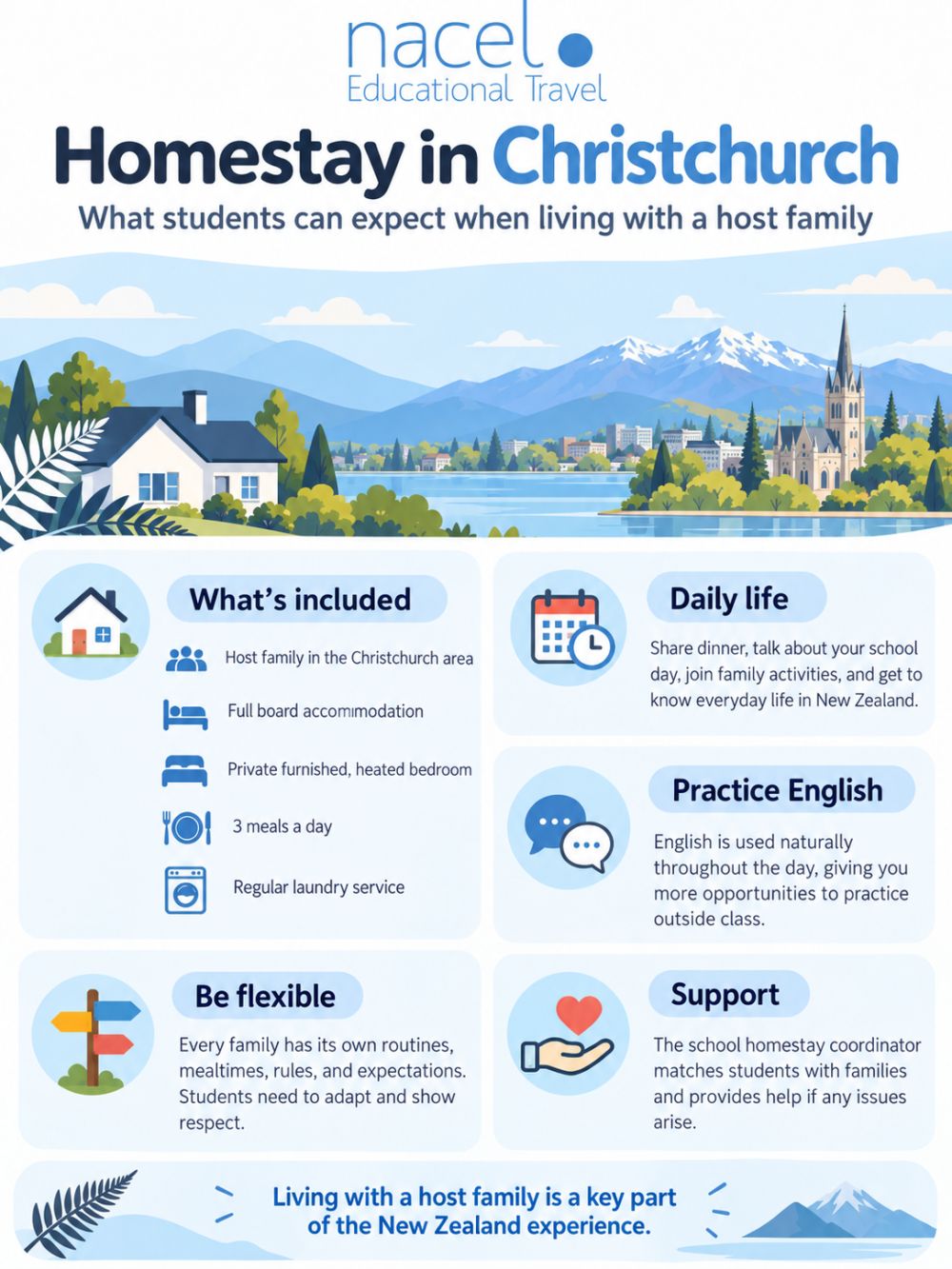
Staying with a host family is a major part of the experience. Students live with a family in the Christchurch area and receive full board. You have your own furnished, heated bedroom and receive three meals a day and regular laundry service.
Living with a host family allows you to experience everyday life in New Zealand beyond school.
You will eat dinner together, talk about the school day, participate in family activities, and become familiar with the routines of a local household. English is used naturally throughout the day, giving you more opportunities to practice outside of class. However, staying with a homestay also requires flexibility.
Every family has its own habits, mealtimes, rules, and expectations. You need to be willing to adapt to and respect the household routine. This is an important part of living abroad.
The school homestay coordinator and Nacel are responsible for matching students with families and providing assistance if issues arise.
What is host family life really like?
There is no single type of New Zealand host family.
You will live with a family that has children, while other students will stay with couples or other family types. The most important thing is that you are prepared to take part in everyday family life. You shouldn't see the homestay as just a place to sleep.
This is also where you often speak the most natural English. Conversations at home are not planned around a lesson. They're about dinner, school, weekend plans, or normal daily life.
That kind of practice can be very helpful to improve your English.
Also read this article:Tips for the first days living with your host family abroad!
Making friends and becoming part of the school community
Are you having concerns about making friends before arriving in New Zealand for your exchange program? That is normal. Starting at a new school is already a big change. Doing it in another country is even more of a change.
As an international student, you will meet both New Zealand students and international students.
One former student described becoming friends with both groups during a year in Christchurch, which was a very interesting experience for him. At first, talking to new people was difficult, but over time, he became more comfortable and confident communicating with others.
Sitting with classmates at lunch, joining a club, playing sports, or simply talking to the same people every day can really help. If you are willing to participate and start conversations, you generally have more opportunities to build connections.
What is it like to live in Christchurch as a High school student?
Christchurch is located on the east coast of New Zealand’s South Island.
The city offers students access to parks, beaches, walking trails, sports facilities, and other recreational activities. The area is home to a number of schools, including several secondary schools and institutions of higher education.
Experiencing Christchurch as an international student is different from seeing the city as a tourist. You learn your route to school, get to know your neighborhood, and develop a weekly routine. You will have a favorite place to meet friends or a regular activity after school. This everyday experience is one of the main differences between traveling abroad and living abroad for several months.

Preparing for a high school experience abroad
A high school program abroad requires some preparation.
Students joining the Christchurch program are expected to have good academic results and previous English study. You also need to follow the rules of the school, host family and local program staff.
It is also important to discuss academic recognition before departure. Nacel cannot guarantee that subjects, grades or qualifications completed in New Zealand will automatically be recognized by your school at home. Students and families should check this with the home school in advance.
That conversation is best done early, especially if you are considering a semester or full academic year.
Choosing the right length of stay
Nacel offers different study lengths in Christchurch, including a school term, semester and academic year. A shorter stay can be suitable if you want to experience New Zealand school life without spending a full year abroad.
A semester gives you more time to settle in, develop friendships and become familiar with your host family and school. An academic year offers the longest period of immersion and gives you more time to become part of the school routine. The right choice depends on your age, goals, school situation at home and readiness to spend an extended period abroad.
If you are short on time opt for our Homestay and high school program from 12 weeks
More than a school experience
Studying high school in New Zealand gives you the chance to experience another education system while also becoming part of daily life in Christchurch. You attend classes with local students, take part in school activities, use English every day and live with a New Zealand host family.
The experience will be different for every student. You will remember a favorite class, a sport, a host family dinner or the first time you felt confident speaking English with friends.
What matters most is being open to a new routine and willing to participate.
For current dates, program lengths, requirements and fees, students and families can visit Nacel’s High School Program in Christchurch.

Jojanneke is the Nacel Educational Travel Team Manager and has been working with Nacel since February 2022.
She communicates with students from all over the world to understand exactly what they are looking for and to advise them on the programs that best suit their interest and their budget. She feels very fortunate to have had the opportunity to travel to many different countries and work in the Netherlands, Guatemala, Spain, Portugal, France, Bulgaria and Luxembourg. She studied at a Dutch university.
Jojanneke also participated in a Spanish language stay in Guatemala and has studied in France. This is why she knows perfectly the needs of future exchange students. But as a mother herself, she also understands the needs and concerns of parents who send their child abroad. She provides the empathy and understanding that parents and students need throughout the process of their project.
 A semester or academic year can be difficult to fit around school at home. Chile offers another option because its school calendar runs at a different time of year from many countries in the Northern ...