

Parent Handbook
Sending your child abroad is a big step for the whole family. Here is everything you need to know, and how Nacel supports you and your child before, during and after the stay.
Parents are part of the journey from day one
Choosing a stay abroad is a family decision. A Nacel advisor takes the time to understand your child's goals, personality and maturity, as well as your timing and budget, and recommends the program that fits best.
Since 1957, we have helped students discover a new language and culture by living it from the inside: in a host family, a local school, a summer camp or a language classroom.
What makes a Nacel stay different
Your child shares daily life with local people and speaks the language from day one.
From one week at camp to a full academic year, in 25 destinations and 9 languages.
Member of UNOSEL, ASEPROCE and CSIET, with partners we have worked with for years.
French, English, Spanish, Portuguese and Dutch.
Branches and local representatives in 50+ countries, on five continents.
Your quote shows exactly what is included, with no hidden costs.
Which program fits your child?
The level of supervision depends on the program. The younger or less independent your child, the more structured the program should be.
Program | Ages | Supervision | Length |
|---|---|---|---|
Summer Camps | 11–17 | Fully supervised, full schedule | From 1 week (2 recommended) |
Homestay Immersion | 13–18 | Host family + local representative | 2–16 weeks |
Homestay with a private teacher | From 11 | Lives with the teacher's family, fully supervised | 1–50 weeks |
High School Abroad | 13–18 | Host family + local coordinator | Term, semester or year |
Language School | 16+ | Independent | Flexible, by the week |
How we look after your child
Your child's well-being comes first. These are the safeguards in place on every Nacel program.
-
Carefully screened host families
Families provide criminal and police records, ID and references, and are interviewed and visited at home before they are approved. Many are recommended by schools or by other host families.
-
Trusted partners
Schools, camps and residences go through a rigorous selection, and we build long-term relationships based on shared quality standards.
-
A local contact close by
A Nacel local representative or coordinator checks that your child is doing well and that the host family and school are happy, and steps in quickly if something goes wrong.
-
A 24/7 emergency line
An English-speaking team is reachable day and night. You receive the number before departure, and you are told promptly if there is ever an emergency.
-
Help if your child is unwell
The local representative and host family help find a doctor. For hospital care or repatriation, the insurer is contacted, with support from our emergency team.
If things don't click with the host family
Your child should first talk openly with the family, then contact the local coordinator, who works with everyone to find a solution. Most situations are resolved this way. A change of host family is only considered as a last resort and depends on availability.
Rules your child agrees to
Attend school or classes, respect host family and program rules (including curfews), and never drive, smoke, drink alcohol or use drugs.
From first call to departure day
-
Free consultation
Talk with an advisor about your child's goals, language level and readiness. You receive a personalised quote with everything that is and isn't included. High school students also have an interview with Nacel at this stage, before any payment.
-
Pre-booking and deposit
Fill in the pre-booking form and pay the 300 USD deposit to start the enrollment process.
-
Application
Once the deposit is paid, your child completes the application with transcripts, recommendations, a letter to the host family, a short video and medical records.
-
Passport and visa
Your child needs a valid passport and, for many programs, a visa. Nacel does not handle visa applications, but issues a letter of acceptance to support yours.
-
Travel arrangements
Wait for final confirmation before booking flights. Depending on your child's maturity, you can book the airline's unaccompanied minor (UM) service; age rules vary by airline. If you choose this service, let us know right away. Airport transfers are included or available, depending on the program.
-
Matching with a family and school
Our local coordinators match your child on shared interests and compatibility. Once the placement is confirmed, you are encouraged to get in touch with the family by email or video call.
-
Arrival
Before departure, you and your child receive all the information needed for a successful stay. On arrival, your child is welcomed by the host family, school or Nacel staff.
-
Choose the camp together
Book a free consultation to compare camps by age, language and activities. Involve your child in the choice and read the camp description together, so they know what to expect.
-
Book online
Fill in the pre-booking form and pay the 300 USD deposit. If your child has allergies, a special diet or takes medication, mention it to your advisor from the start.
-
Complete your file on MyTrip Abroad
Once the deposit is paid, you receive a login to our MyTrip Abroad portal. There you share your child's health information, including allergies, medication and dietary needs, so the camp is fully prepared.
-
Documents and confirmation
Send us a copy of your child's travel insurance, passport and enrollment form, plus any other documents needed for the camp. Once everything is complete, you receive final confirmation of your child's place.
-
Travel arrangements
Book flights only after final confirmation. Depending on your child's maturity, you can book the airline's unaccompanied minor (UM) service; age rules vary by airline. If you choose this service, let us know right away. Transfers are included at some camps and optional at others.
-
Arrival at camp
Camp staff welcome your child and run a full program of lessons, activities and excursions. You receive the 24/7 emergency number before departure.
When to start planning
6–12
months ahead
For one-year or six-month high school programs, which require a student visa.
3–6
months ahead
For high school and homestay programs under 90 days, with no visa needed.
Up to 2
months ahead
For homestays and language camps.
Packing checklist
- Passport, visa and insurance papers in hand luggage
- Medication in its original box, with a current prescription in your child's name
- Vaccination records
- A plug adapter for electronics
- A small gift from home for the host family
- Light luggage, packed for the season at your child's destination
Staying close, without holding them back
Feeling homesick in the first weeks is normal. Regular contact is reassuring, but daily calls can slow down your child's integration and even make homesickness worse. Agree on a rhythm together before departure.
Before departure
Meet the host family by email, phone or video once the placement is confirmed.
During the stay
Your child can call or message you, following the host family's house rules. Day to day, the host family and local coordinator are their first contacts.
In an emergency
You can always reach the 24/7 emergency line, and we contact you promptly if anything happens.
Progress updates
Your Nacel advisor keeps you updated on how your child is doing throughout the stay.
Camps are short and full of activities, and most campers settle in quickly. A short call every few days is usually enough; frequent calls can make it harder for your child to enjoy the experience.
Before departure
You receive the camp details and emergency contacts before your child leaves.
During camp
Phone use is often limited to set hours, so campers can enjoy the activities. Camp staff are your child's contacts on site.
In an emergency
Camp staff and the 24/7 emergency line are always reachable, and we contact you promptly if anything happens.
Camp updates
Some camps have a parent portal where they post photos of the campers every week. Your advisor will tell you how to access it. Please note that these photos are for families only and must not be shared or published anywhere.
What's included, and what to budget for
Every program page lists exactly what is included. No hidden costs: your quote shows everything up front.
Usually included
- School or camp placement
- Accommodation and meals
- Local support and the 24/7 emergency line
- Orientation
- Letter of acceptance, if needed for a visa
- Depending on the program: transfers, excursions
Not included
- International flights
- Passport and visa fees
- Travel insurance
- Pocket money and personal expenses
- Optional activities and tours
- Some school costs (uniform, books)
€50–80
Pocket money per week
Around €50–80 per week in Europe. In other destinations it may vary, depending on your child's expenses and program.
Insurance
Mandatory for students under 18. It must cover medical expenses, hospitalisation and emergency repatriation, and you send us a copy before departure.
Looking for help with costs? Explore Nacel scholarships.
With you before, during and after
Behind every student is a network of people working together: your Nacel advisor, our local offices and coordinators, the host family and the school.
Before
- One-to-one advice on the right program
- Help with the application and documents
- Host family and school matching
- Pre-departure orientation
During
- Welcome on arrival
- Check-ins from the local coordinator
- Mediation with the host family or school
- 24/7 emergency line
After
- Certificate of attendance (language and high school programs)
- Post-return interview, when applicable
- Loyalty and referral program
Questions parents ask us
How do I know if my child is ready?
Your child should genuinely want to go, be curious about the language and culture, and be independent enough to handle small problems and some homesickness. Our advisors can help you assess readiness.
Does my child need to speak the language already?
Not for most programs: beginners are welcome at camps and language schools. High School Abroad usually asks for at least two years of language study.
Can we choose the host family?
For most programs, no: the application lets you share preferences and needs, such as pets, allergies or diet, and families are matched on shared interests. They may or may not have children of the same age.
The exception is Homestay with a private teacher: we propose a teacher and host family matched to your child, and you can see their profile before you enroll.
When will we know where our child is placed?
For high school, you usually receive the host family details about one month before departure. For homestays, it is usually about two weeks before arrival. Applying early gives our coordinators more time to find the best match for your child.
Can special diets or allergies be accommodated?
It depends on the program. Please mention any special diet or allergy to your advisor as early as possible, so we can check whether it can be accommodated.
Will school credits transfer back home?
It depends on the program and on your child's home school. Check with your child's school counselor and your Nacel advisor before departure.
Can my child travel on their own during the stay?
Independent travel is generally restricted. Exceptions depend on the destination and require written parental permission.
Can we speak to families who have done it before?
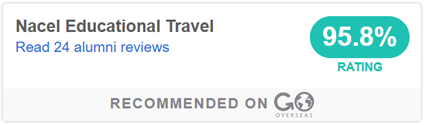
Yes. Read reviews on Google, Go Overseas and Go Abroad, or ask us to put you in touch with former students and their parents.