

 Liby from Nacel interviews Saskia, an Australian student, about her study abroad experience in France: host family life, French school, Christmas traditions, food, and what helped her feel confident.... read
Why adult learners succeed in private immersion programmes. It is never too late to learn a language.
“I should have done this years ago.”
We hear this sentence often from our adult language students. Sometimes on the first day of a private teacher program and many times after they return from their trip when real conversation in the target language becomes so much easier.
Adults arrive with excitement and doubt at the same time. For years, many have believed that language learning belongs to children. That there is a perfect window. That once it closes, fluency becomes unrealistic.
But that idea is incomplete.
Research in psycholinguistics shows that language is not something we acquire once and for all in childhood. In the research' Beyond Words: How We Learn, Use, and Lose Language' language is described as a system shaped by use, experience, and environment throughout life. It evolves. It adapts and can grow at any age.
The real difference is not whether adults can learn. It is how they learn. And that difference is often an advantage.
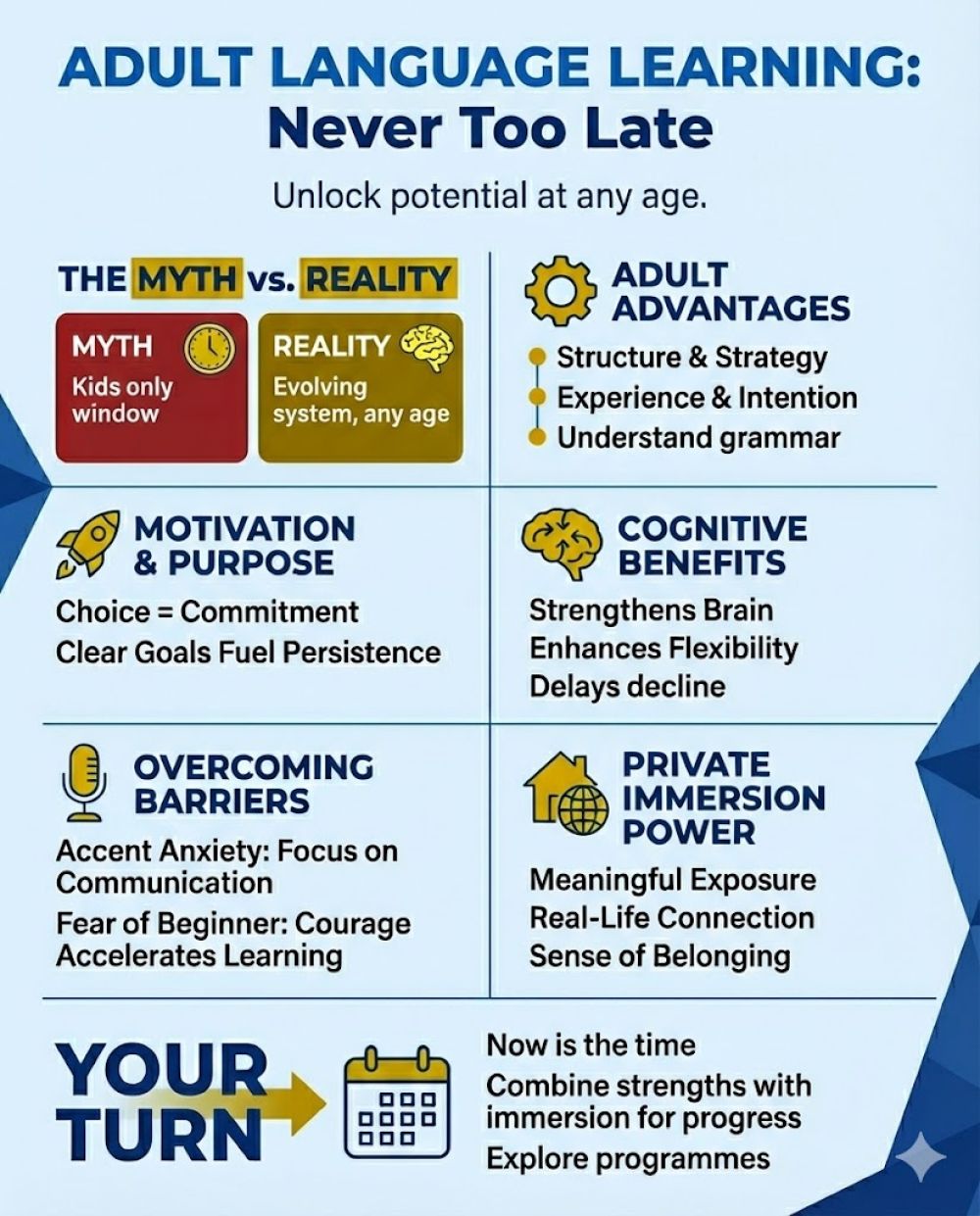
Adults bring structure, strategy and experience

Children learn implicitly. They absorb patterns through repetition and exposure. Adults, however, arrive with a fully developed linguistic system.
As an adult you already understand grammar. You know what a past tense does. You can compare structures between languages. You can ask specific questions and understand detailed explanations.
This capacity to reflect is powerful.
One of our adult students in Spain, aged 47, was convinced she would struggle. She had not studied Spanish in over twenty years. On her third day of one-to-one lessons, she told us that she finally saw the pattern, that it actually makes sense.” This is the strength of being totally immersed in a language while staying at your Private Teachers house and continuing learning beyond the classroom.
Research from MIT and Harvard University has even challenged the simplistic idea that language learning ends in childhood. A large-scale study on grammar acquisition found:
“It is possible to learn new languages to a high level well into adulthood.”
You may not learn in the same way as a child. But you are absolutely capable of high proficiency, especially with meaningful exposure and immersion. Adults combine intuition with strategy, reflection with practice and experience with intention.
Motivation changes everything

Children usually learn because they must. Adults learn because they choose to and choice creates commitment.
Many adult learners join a private teacher program or a language school for a clear reason. A relocation project. A new career opportunity. A partner from another country. A long-awaited personal goal. This clarity fuels persistence.
One student preparing for a move to France told us, “I need to feel comfortable in meetings. I want to understand jokes. I don’t want to just survive, I want to belong.”
When language is connected to identity and future plans, progress becomes tangible. Every new word has a purpose and every conversation builds confidence.
As described in Beyond Words: How We Learn, Use, and Lose Language, language strengthens through meaningful use. Adults often seek exactly that. Real conversations. Real situations. Real stakes.
This depth of engagement accelerates learning in ways that go beyond textbooks.
Learning a language also strengthens the brain

There is another dimension that often surprises adult learners. Language learning is not only about communication. It is about cognitive flexibility.
Research by cognitive neuroscientist Ellen Bialystok at York University has shown that bilingualism enhances executive control and mental flexibility. In her work on lifelong bilingualism, she explains: “The bilingual mind is more resilient.”
Her studies suggest that managing two languages strengthens attention and may even delay symptoms of cognitive decline later in life. In other words, learning a language as an adult is not just possible. It is beneficial.
Your brain is not closing doors. It is building new pathways.
Accent anxiety is overrated
It is true that young children are especially sensitive to new sound systems. They may develop near-native pronunciation more easily. But communication is not defined by perfection.
Adults can improve pronunciation significantly with focused, personalized feedback. In a private teacher setting, time is dedicated to your specific challenges. Your rhythm, your intonation and your recurring sounds. And something else happens.
Confidence replaces hesitation.
A student in Italy shared after two weeks of immersion, “I stopped translating in my head. I just started speaking.” Her accent did not disappear overnight. But her fear did, and fear is often the real barrier.
Immersion feels different as an adult

Living abroad as an adult adds another dimension to language learning. You become more aware of social cues. You pay more attention to tone. You reflect on cultural differences. You immediately connect language to daily life.
In a one-to-one teaching programme, lessons don't end when the class is over. Conversations continue over dinner or during a walk. You will pick up vocabulary at the market or at a local shop, and expressions while walking through the city and interacting with the locals.
Adults often deeply appreciate these nuances. They understand that language is more than just vocabulary. Language functions as a sense of belonging.
In Beyond Words: How We Learn, Use and Lose Language, language is described as something that is shaped by interaction. Immersion multiplies these interactions. Exchanges strengthen the system and make progress visible and personal.
The real barrier is not age. It is fear
Many adults hesitate not because they are unable to learn, but because they feel they should already know how to do things.
They are used to being competent. Skilled. In control. Becoming a beginner again requires courage, and not everyone is willing to do it.
Yet this courage often marks a turning point, one which can be pivotal in many different situations. When mistakes are made and imperfections spoken by adults, their learning is accelerated. Language grows through use. Not silence.
If you have been waiting, this is your sign
The idea that language learning is only for children has discouraged many adults. But the reality is more encouraging.
Adults bring structure, strategy, emotional depth and intention to the process. When combined with personalised one-to-one teaching and cultural immersion, these strengths can lead to remarkable progress.
If you have been considering enhancing your language proficiency by enrolling in a private teacher programme abroad, now might be the ideal time to make that move.
Our private teaching programmes worldwide are specifically designed for adult learners who want to make meaningful progress and experience cultural immersion while receiving individual attention.
If you would like to explore different destinations, programme lengths, or languages, our team will be happy to help.

Jojanneke is the Nacel Educational Travel Team Manager and has been working with Nacel since February 2022.
She communicates with students from all over the world to understand exactly what they are looking for and to advise them on the programs that best suit their interest and their budget. She feels very fortunate to have had the opportunity to travel to many different countries and work in the Netherlands, Guatemala, Spain, Portugal, France, Bulgaria and Luxembourg. She studied at a Dutch university.
Jojanneke also participated in a Spanish language stay in Guatemala and has studied in France. This is why she knows perfectly the needs of future exchange students. But as a mother herself, she also understands the needs and concerns of parents who send their child abroad. She provides the empathy and understanding that parents and students need throughout the process of their project.
 You have decided France is the right place for your child to learn French. Good call. Now the harder question: which type of stay is the right fit?Nacel has been running programmes in France for over ...